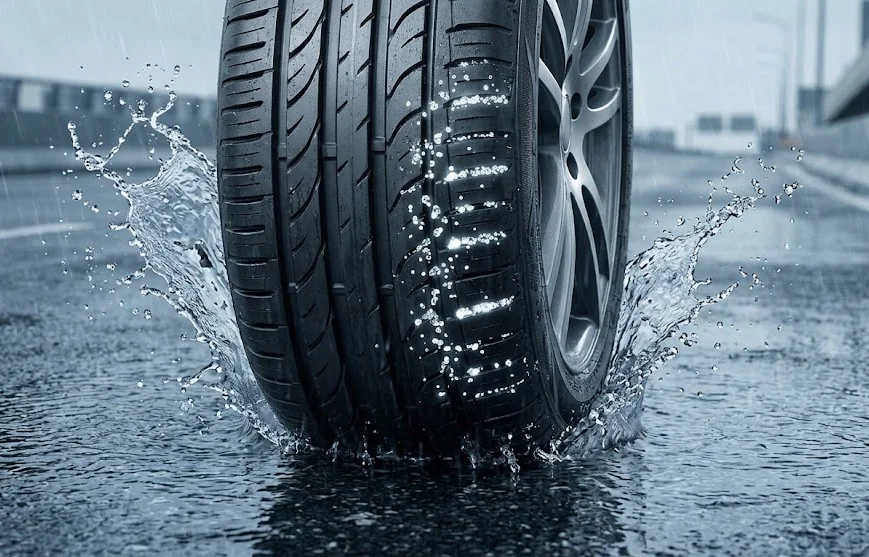
Fuel efficiency is an important consideration in modern tire development. As vehicle manufacturers and tire producers seek to reduce energy consumption without compromising safety or durability, the materials used in tire tread compounds have become increasingly important. Among these materials, precipitated silica plays a significant role in developing tires with lower rolling resistance and reliable wet grip.
Understanding how silica in tires works can help manufacturers evaluate material formulations, improve production consistency, and meet changing performance requirements. JSJ Silica develops its TIRESIL® precipitated silica range to support tire compounds that balance fuel efficiency, traction, and wear resistance.
Understanding the Role of Silica in Tires
Silica is a reinforcing filler used in rubber formulations, particularly in tire tread compounds. Traditionally, carbon black has been widely used to reinforce tire rubber. Silica provides an additional formulation option that can help manufacturers optimize the relationship between rolling resistance, wet grip, and tread durability.
The performance of silica depends on more than the quantity added to the compound. Particle characteristics, surface properties, dispersion quality, and compatibility with other ingredients all influence the final rubber properties. When properly formulated with suitable silane coupling agents, silica can reinforce the rubber while helping control energy loss during tire deformation.
This combination makes silica an important material for fuel efficient tires, including applications where both road safety and energy performance are essential.
How Silica Compound in Tires Reduces Rolling Resistance
Rolling resistance refers to the energy a tire loses as it repeatedly deforms and recovers while moving across the road. Part of this energy dissipates as heat within the rubber. The more energy lost during each rotation, the more power a vehicle needs to maintain its movement.
A well designed silica compound in tires can reduce these losses by modifying the viscoelastic behavior of the tread rubber. When silica is properly dispersed and coupled with the rubber matrix, the compound can dissipate less energy under operating conditions associated with rolling resistance.
For conventional vehicles, lower rolling resistance can help reduce fuel consumption. For electric vehicles, it can contribute to improved driving range by reducing the energy required to keep the vehicle moving.
However, silica does not automatically guarantee better fuel economy. The final result depends on the complete tread formulation, silica characteristics, coupling chemistry, mixing conditions, tire construction, and operating environment. Material selection and formulation optimization must therefore work together to achieve measurable improvements.
Balancing Fuel Efficiency with Wet Grip and Durability
Reducing rolling resistance is only one part of tire performance. Manufacturers must also maintain wet traction, mechanical strength, and resistance to tread wear. A formulation that improves energy efficiency but compromises braking performance or service life may not meet the requirements of its intended application.
Silica offers an opportunity to balance these competing demands. With appropriate formulation and dispersion, it can support lower rolling resistance while contributing to wet grip and tread reinforcement. These properties are particularly relevant to green tires designed to improve energy efficiency without sacrificing essential driving performance.
Silica distribution is also important for durability. Poor dispersion can create particle agglomerates that interfere with consistent reinforcement and processing. High dispersibility helps distribute the filler more evenly throughout the rubber, supporting more consistent compound properties.
For tire manufacturers, the objective is not simply to maximize silica loading. It is to select a suitable silica grade and optimize the formulation around the required balance of efficiency, grip, and wear resistance.
Why Silica Quality and Processing Matter
The effectiveness of silica in tire production depends on both raw material quality and manufacturing control. Surface characteristics influence interactions with silane coupling agents, while particle structure and dispersibility affect filler distribution during mixing.
If silica is difficult to disperse, manufacturers may encounter inconsistent compound properties, longer processing requirements, or challenges in achieving the intended reinforcement. A suitable grade with controlled material characteristics can help improve dispersion and support a more predictable processing window.
Mixing temperature, mixing sequence, coupling agent selection, and vulcanization conditions must also be managed carefully. These factors influence how effectively silica interacts with the rubber and how consistently the compound performs in the finished tire.
For manufacturers evaluating new materials, laboratory testing and production trials remain essential. Rolling resistance, wet grip, abrasion resistance, mechanical properties, and processability should be assessed together rather than as isolated indicators.
JSJ Silica Supports Efficient Tire Compound Development
At JSJ Silica, the TIRESIL® range of precipitated silica is developed for tire formulations that require low rolling resistance, wet grip, and reliable reinforcement. The range includes TIRESIL 115MP, 165MP, 175MP, and 200MP, providing options for manufacturers evaluating different tread compound requirements.
High dispersibility is a key consideration in these materials. More uniform filler distribution can help improve compound consistency, while suitable surface characteristics support effective silane coupling and rubber reinforcement. These properties are relevant to manufacturers developing green tires and electric vehicle tires, where energy efficiency must be considered alongside grip and durability.
Selecting the right grade requires evaluating the intended application, rubber system, processing conditions, and target performance specifications. JSJ Silica offers technical support, sample access, and customized material solutions to help manufacturers assess suitable options for their formulations.
Building More Fuel Efficient Tires Through Material Innovation
Silica compound technology offers tire manufacturers a practical way to address the relationship between rolling resistance, wet grip, and durability. By reducing energy loss during tire deformation, a properly optimized silica filled tread can contribute to lower fuel consumption in conventional vehicles and improved energy efficiency in electric vehicles.
Achieving these benefits requires more than adding silica to rubber. Filler quality, dispersion, coupling chemistry, and process control all influence the final result. With its TIRESIL® precipitated silica range, JSJ Silica supports manufacturers seeking to develop consistent, performance focused tire compounds.
