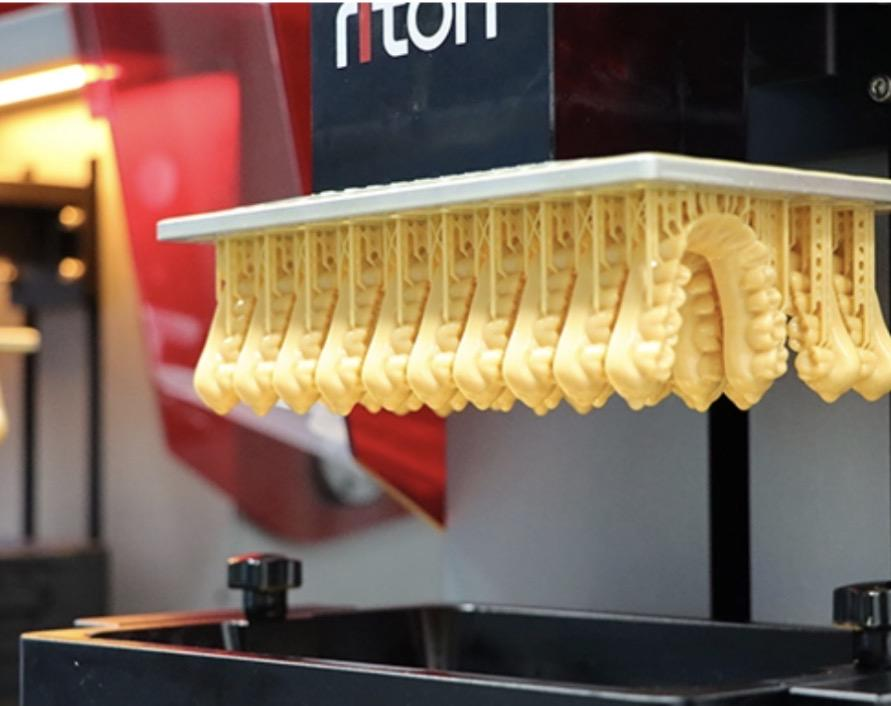
In modern digital dental laboratories, achieving optimal fit, structural integrity, and production efficiency requires a thorough understanding of additive manufacturing variables. Dental technicians and procurement managers frequently encounter dimensional discrepancies, surface imperfections, or premature print failures. These challenges often stem not from a single isolated component, but from the complex interaction between hardware performance and photopolymer material characteristics.
Understanding how printer optics and resin chemistry influence one another is essential for streamlining workflows and ensuring predictable clinical outcomes across diverse workloads.
Positioned as an end-to-end ecosystem partner for digital dental manufacturing, Ritondelivers integrated solutions covering advanced equipment, digital platforms, and responsive local technical support. Its engineering work centers on aligning optical systems with application-specific resin chemistries to help reduce quality-affecting process variables.
Matching Photopolymers with a Modern resin material 3D printer
A central question raised by senior lab technicians is: How do variations in light source intensity and wavelength impact the conversion rate of different photopolymer resins during high-speed printing on a professional resin material 3D printer?
The answer lies in energy transfer. Every photopolymer formulation requires a specific photoinitiator package tailored to absorb precise light spectrums—most commonly around 385 nm or 405 nm. When a hardware platform utilizes a stable light source with high uniformity, it delivers consistent photon density across the entire build area. If a machine’s optical intensity fluctuates, resins with narrow curing windows may experience under-curing at the periphery, resulting in soft margins on crown and bridge models or distorted surgical guides.
Conversely, excessive optical energy can cause light scattering within translucent or highly filled materials, leading to dimensional overgrowth and loss of fine anatomical detail. Modern resin material 3D printer systems manage this through precise optical calibration. For instance, equipment utilizing high-resolution monochrome LCD screens and advanced light uniformity technologies can maintain consistent curing depths, allowing technicians to process intricate dental geometries without unexpected dimensional shrinkage.
Mechanical Adaptability and Precision Control
When producing diverse dental appliances—ranging from master models and denture bases to occlusal splints—the mechanical demands placed on the hardware shift dramatically. Technicians often ask: Can a single printer handle both rigid model resins and compatible flexible dental resins with appropriate parameter adjustments?
Hardware stability directly dictates how well a machine accommodates varying resin viscosities and peel forces. Rigid materials require strong initial adhesion and clean separation from the release film to prevent layer delamination. In contrast, softer, more compliant formulations demand gentle peel mechanics to preserve fine structural features without tearing or distortion.
Advanced systems designed for professional dental laboratories integrate intelligent software controls and optimized mechanical structures to manage these influential variables. The RXDent-L230 features a 228 × 128 x 150 mm molding area, a stated accuracy of 30 um, and an 8K resolution of 7680 x 4320 pixels.
Equipped with a 385 nm light source and a printing speed of 1-8 seconds per layer, the RXDent-L230 supports layer-by-layer production of compatible dental photopolymer resins. In addition, built-in anti-aliasing algorithms refine pixel transitions, helping avoid jagged edges on key restoration margins across different resin viscosity levels.
Real-World Application: Balancing Production Workflow
Consider a mid-sized dental laboratory handling daily batches of orthodontic aligner models alongside complex implant cases. In a real-world production scenario, the lab might need to switch from a rigid model material to a specialized flexible resin 3D printer medium within the same operational shift to meet tight patient delivery deadlines.
If the equipment lacks preset parameter profiles or flexible exposure controls, technicians spend excessive time running test prints and manually calibrating lift speeds. This trial-and-error approach wastes expensive material and delays turnaround times for urgent clinical cases. When the printer and resin are designed to complement each other within a unified digital ecosystem, pre-optimized software profiles streamline slicing and parameter assignment. Technicians simply select the verified material profile, load the build file, and initiate production with confidence that the mechanical stress and optical exposure match the specific polymer’s reaction kinetics.
Optimizing Quality Control in Dental Manufacturing
Consistency in digital dentistry extends beyond initial printing accuracy; it encompasses post-processing behavior and long-term structural stability. Resins with different filler contents react differently during washing and secondary UV curing. If an optical system produces internal stress concentrations due to uneven light distribution, the subsequent post-curing phase can induce warping or micro-cracks.
To mitigate these risks, laboratories benefit from utilizing integrated hardware and software ecosystems that regulate every stage of production. By pairing high-precision optical hardware with validated resins, manufacturing facilities minimize operator error and reduce scrap rates. Maintaining open communication channels with equipment manufacturers also helps labs receive timely updates for newly released biocompatible materials, keeping their production capabilities aligned with evolving clinical standards.
Ultimately, aligning printer specifications with material chemistry transforms additive manufacturing from a variable craft into a predictable, scalable industrial process.
